NB-IoT Sensors for Digital Waste Management Indoors
How can connected sensor technology enable demand-driven waste collection indoors?
Across enclosed environments such as office buildings, shopping centers, hospitals, educational facilities and industrial properties, the demand for software-based solutions that make waste collection more efficient and cost-effective is growing rapidly.
This is exactly where NB-IoT sensor technology comes in. By using connected sensors, fill levels in waste bins can be monitored digitally, service operations can be scheduled more accurately, and unnecessary manual checks can be avoided. For businesses, this creates clear value: waste collection processes can be managed more precisely, service effort can be reduced, and building resources can be deployed more efficiently.
What is NB-IoT and why is it relevant for indoor environments?
NB-IoT stands for Narrowband Internet of Things. It is a wireless communication standard developed specifically for IoT applications. The technology is designed to transmit small amounts of data reliably, energy-efficiently and over long distances. This makes it particularly well suited to digital waste management inside buildings.
In some properties, maintaining stable data transmission can be challenging. Thick walls, basement areas, utility shafts and hard-to-access technical zones can limit the performance of many wireless technologies. NB-IoT offers clear advantages in these environments because it is designed to provide reliable connectivity even in demanding building structures.
This makes the technology especially valuable for waste management, as sensors can also be deployed in locations where manual inspections have traditionally been time-consuming, costly or simply inefficient.
How does digital waste management with NB-IoT sensors work?
In digital waste management, waste bins are fitted with sensors that continuously capture relevant operational data. This typically includes:
- fill levels
- usage intervals
- temperature readings
- movement or status data
- critical changes indicating a need for action
This data is automatically transmitted to a central platform, where it can be visualized, analyzed and used to support operational decision-making. Instead of checking or emptying bins at fixed intervals, collection can be organized according to actual demand.
Benefits of NB-IoT sensor technology in digital waste management
The use of connected sensors can significantly improve the cost-efficiency of waste management processes.
1. Demand-driven collection instead of fixed routines
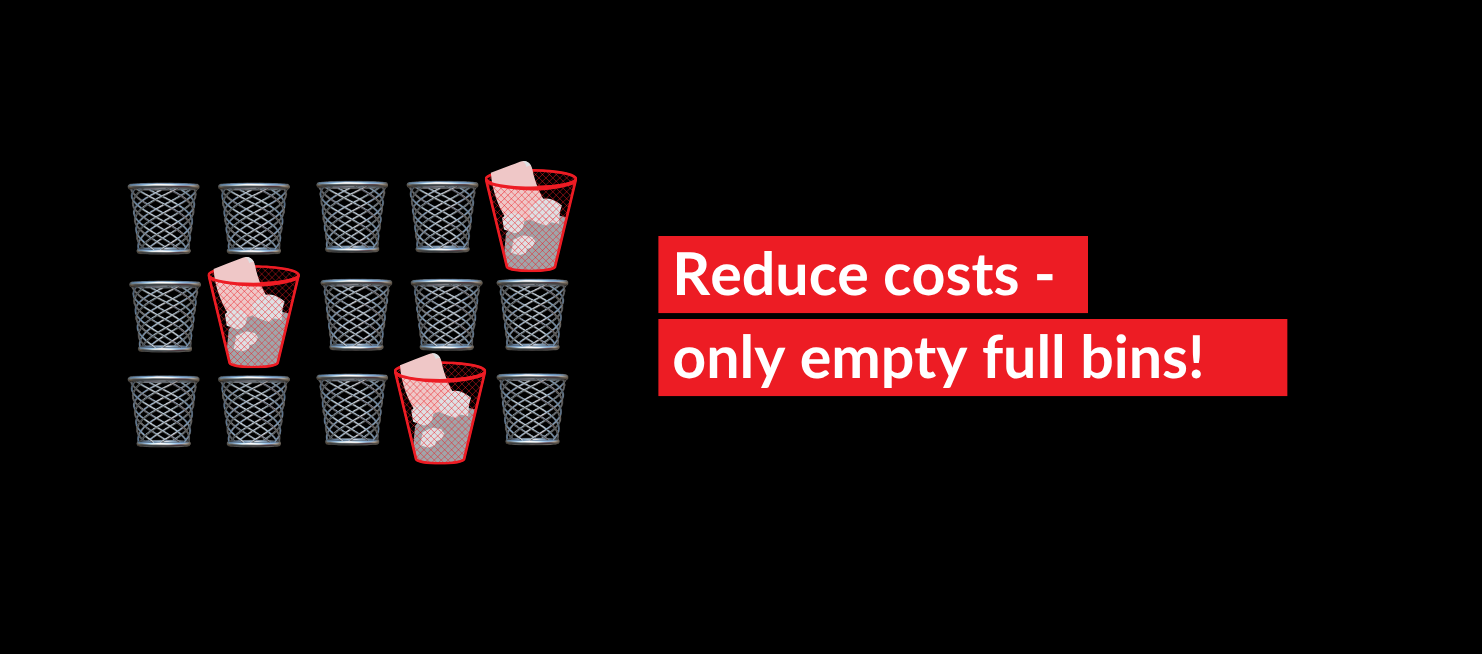
In many buildings, waste bins are emptied according to fixed schedules, regardless of whether they are already full or still have sufficient capacity. Sensor-based systems make it possible to identify actual demand. This eliminates unnecessary inspection rounds while enabling better service planning.
2. Lower operating and labor costs
When collections are triggered based on actual fill levels, the workload for both in-house teams and external service providers is reduced. Staff can be deployed where action is genuinely required, allowing resources to be used more effectively and day-to-day operations to run more smoothly.
3. Improved service quality
Overflowing bins have a negative impact on user experience, hygiene and the overall appearance of a site. In high-traffic indoor environments in particular, reliable collection management is essential. Digital systems make critical fill levels visible at an early stage, allowing action to be taken in time.
4. Better data for better decisions
Sensor technology provides visibility into usage patterns and peak demand periods. Organizations can identify which areas are used most heavily, where additional bins may be needed and how waste management processes can be improved over the long term.
5. Support for sustainability goals
Intelligent waste management helps reduce unnecessary trips and inefficient processes. At the same time, workflows become more structured and easier to track. This supports companies in operating more sustainably and using resources more responsibly.
Typical indoor use cases for NB-IoT sensors
The technology is particularly suitable for buildings and sites with high user frequency, distributed collection points or strict requirements for cleanliness and process reliability.
Typical use cases include:
- office buildings and corporate headquarters
- shopping centers
- hospitals and care facilities
- hotels and hospitality venues
- airports and railway stations
- schools, universities and public institutions
- industrial and logistics sites
Wherever waste management needs to be coordinated on a regular basis, NB-IoT provides the foundation for a digitally managed system that can also be rolled out consistently across multiple sites.
Why NB-IoT outperforms conventional approaches
Many traditional waste management systems still rely on manual visual checks, checklists or fixed service intervals. This is not only labor-intensive, but also prone to error and lacking in flexibility.
By comparison, NB-IoT offers several clear advantages:
- automated data capture
- strong suitability for hard-to-access indoor areas
- scalable deployment across multiple locations
- straightforward implementation without major IT intervention
For organizations looking to digitize building operations, NB-IoT is therefore a practical and effective technology for modernizing facility-related processes.
What matters in implementation
To unlock the full value of digital waste management inside buildings, several factors are particularly important:
- the suitability of the sensors for the specific bin types
- the building structure and installation conditions
- the required transmission frequency
- integration into existing facility management or collection processes
- a clear and user-friendly platform for monitoring and control
The greatest benefit is achieved when the digitalization of individual bins is integrated into a broader smart building or smart waste strategy.
What businesses gain in concrete terms
For companies, the real value lies in both operational and strategic benefits:
- reducing costs through more efficient service processes
- improving workflows through data-driven decision-making
- increasing quality through faster response capabilities
- conserving resources through demand-based collection
- advancing digitalization through connected infrastructure
This turns software-based waste management into a practical tool for creating more efficient and transparent processes.
NB-IoT sensor technology as a key enabler of modern indoor waste management
Digital waste management solutions based on NB-IoT sensor technology help companies optimize indoor collection processes in a targeted way. They improve transparency, reduce operational effort and enable better control across all relevant collection points.
For organizations that want to digitize building-related processes in a practical and scalable way, NB-IoT offers a highly relevant solution with clear real-world benefits. Especially in modern properties with high user traffic, NB-IoT can help manage waste processes in a more data-driven, cost-efficient and transparent way.